Samland to Carnuntum
~ Saturday, September 14, 2019 ~
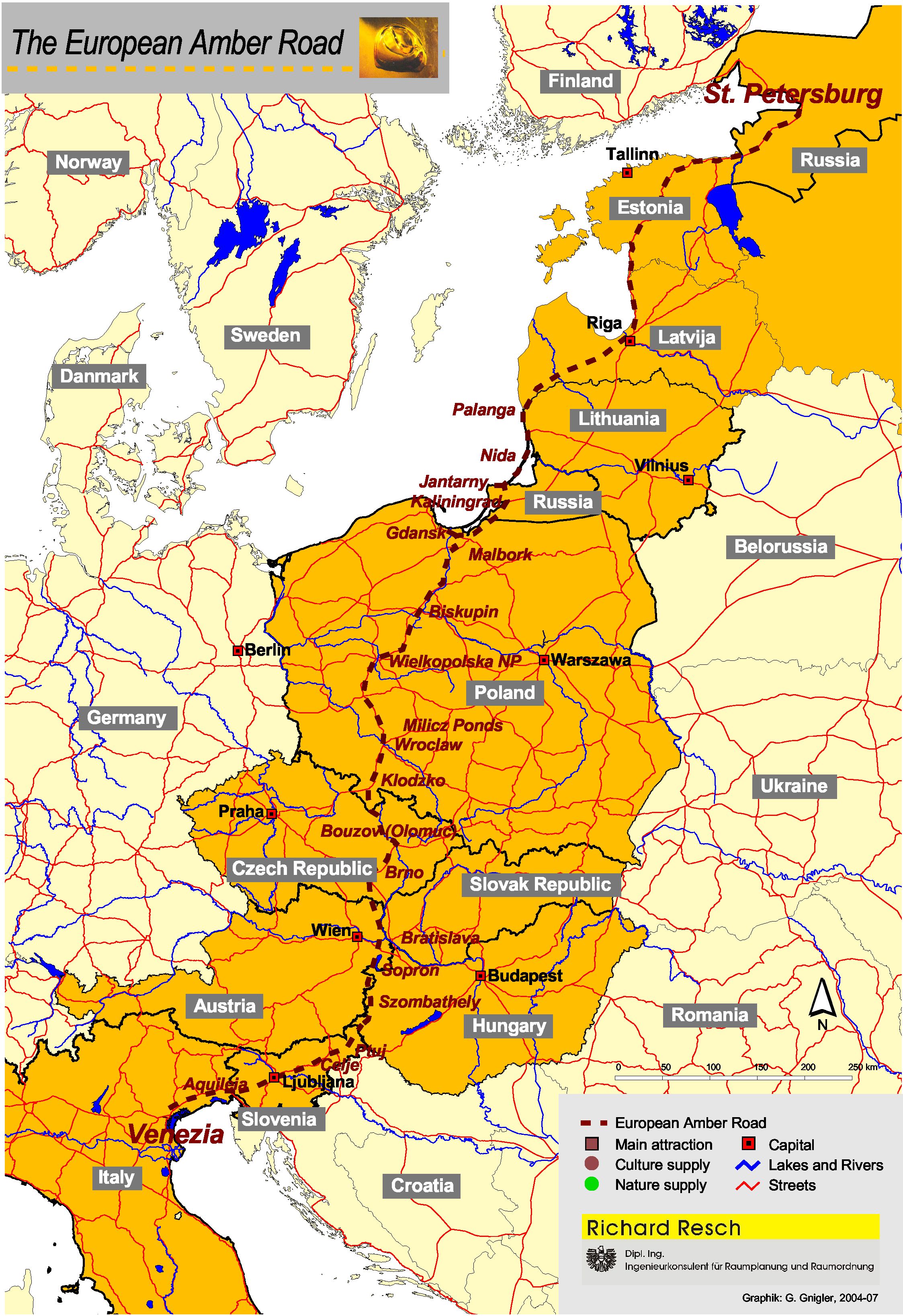
A map of the amber route shows something that does not look like a road. It looks like a river system — which is, in essence, what it was. The route followed water: north to south along the Vistula, across the Silesian lowlands, through the single gap in the mountain chain that separates the North European Plain from the Danube basin, and then south along the Morava river to its mouth at the Danube. From there, east along the river to the great legionary fortress at Carnuntum. The route is roughly two thousand kilometres. The terrain determines nearly all of it.
Elena walked sections of the route in the summer of 2018. Not all of it — the northern terminus in the Kaliningrad oblast requires paperwork — but the southern half, from the Moravian Gate to the Danube, where the landscape is open and the modern roads run alongside river valleys that have been the preferred corridor for north-south movement since before the Bronze Age. The experience of walking a route that old is not romantic. It is primarily logistical. The terrain is the argument.
The northern terminus
The Samland Peninsula — the headland jutting into the Baltic between the lagoons of the Curonian and Vistula spits, today part of the Kaliningrad oblast of the Russian Federation — is the only Baltic amber source that appears consistently in the classical sources. Pliny places the Aestii on its coast. Tacitus describes the same coastline. The amber that was isotopically provenanced in Mycenaean and Egyptian Bronze Age contexts traces, in the majority of cases, to Samland or to the immediately adjacent Baltic coast.
Why here and not elsewhere? The amber deposits of the Samland coast are surface-accessible: they erode from the cliff face and wash onto beaches. The material requires no extraction technology. It is collected rather than quarried. This is what makes the Baltic amber trade possible at a scale the Mediterranean world could sustain over centuries: the raw material is available to anyone willing to walk the beach after a storm.
The documented waypoints
From Samland south: the Vistula crossing near what is now Toruń, attested in Roman sources as a crossing point and confirmed by Iron Age finds. The Silesian lowlands, where the terrain is flat enough to allow several route variants and the archaeological record shows amber workshops processing Baltic material for local consumption — meaning the material was traded in both raw and worked forms as it moved south.
The Moravian Gate: the natural passage between the Sudeten mountains to the west and the Carpathians to the east, at the headwaters of the Morava and the Oder. This is the critical pinch point in the route. The mountains on either side are not crossable with loaded wagons without significant engineering. The Gate is not. It is a wide, gradual corridor, approximately fifteen kilometres across at its narrowest, with reliable water and gentle grades in both directions. Everything moving north-south through this region for the past three thousand years has used it.
From the Gate south along the Morava river to its junction with the Danube. Carnuntum sits on the Danube’s south bank, thirty-five kilometres east of modern Vienna. The legionary fortress was established in the first century CE and remained a major military installation through the fourth century. Amber finds in the excavation record at Carnuntum are not unusual: they include worked pieces, workshop debris, and raw material, indicating that some processing occurred at the entrepôt rather than all of it happening at either end.
The terrain does the work
The route is not a single road. It is a corridor — a zone of preferred movement imposed by the geography of the North European Plain and its southern boundary. Within the corridor, the specific path varied by period, by season, and by what was being moved. Heavy goods followed river valleys. Lighter loads, or loads that needed to avoid river crossings, took higher ground. The Roman road system formalised one set of options within the corridor. The corridor itself was not a Roman invention.
Elena’s observation from walking the southern section: the valleys do the navigation. In the Morava basin, moving north or south, the river is almost always in view and the ground is almost always level. The decisions that required effort from ancient travelers — where to cross, where to stop, where the terrain was defended — left evidence in the form of settlements, fortifications, and crossings that remained in use for centuries. Carnuntum is where it is because the river is where it is, and the river is where it is because the geology that shaped the Alps determined the drainage.
Carnuntum

The Heidentor — the “Pagan Gate,” a triumphal arch built around 354 CE — is the most visible surviving structure at the Carnuntum site. It was built late: the legionary fortress was by then in decline, the amber trade that had partly justified its scale long since restructured by third-century disruptions. The arch is a monument to an installation at the end of its function rather than at its height.
The amber finds at Carnuntum span the full period of the fortress’s occupation. The Carnuntum Museum holds worked amber objects — beads, pendants, unfinished pieces — that document the material passing through and being worked here. This is the entrepôt function: raw material arrives, part of it continues south, part of it is processed locally. The distribution of workshop debris across the site suggests that amber working was not confined to a single craftsman’s quarter but was distributed through residential and commercial areas, which is consistent with a commodity in general supply rather than restricted consumption.
The route south from Carnuntum continues to Aquileia, the major port on the Adriatic that was the Mediterranean terminal of the amber trade. The full route, Samland to Aquileia, is approximately 2,500 kilometres. The distance is real. The terrain that enforces it is unchanged.
In this series
- What the Romans Knew About Amber — Pliny, Tacitus, and the material before the road
- The Moravian Segment — the fork in the route; what the Morava valley held
- The Moved Waymarker — a miliarium found not where milestones belong
Sources
- Carnuntum Museum (Archäologischer Park Carnuntum): carnuntum.at. (Excavation records; amber workshop debris and worked object catalogue)
- Beck, Curt W. “The Origin of the Amber Found at Assur.” Archaeometry 8 (1965): 96–105; and subsequent publications in the same journal.
- Kolendo, Jerzy. “The Amber Trade Routes.” In Roman Frontier Studies 1989. University of Exeter Press, 1991.
- Wielowiejski, Jerzy. “Die spätkeltischen und römischen Bernsteingegenstände in Polen.” Przegląd Archeologiczny 24 (1976–77).